A Millennial's request, "Tear down the walls!"
The following is the original post and the rewrite can be found by clicking here.
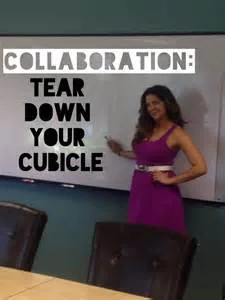
Before one of the 70+ million Millennials reaches for their favourite social media app and criticizes me for speaking on the generation's behalf, I will say that this is on behalf of one of your brethren. If a "tweet" does come my way, I should point out I have hired and worked with dozens and dozens of Millennials, as well as call some of them friends; it does offer me some "street cred" with regard to leading, managing and working with this high potential generation - This brings me to a recent lunch, and the topic at hand.
"They just don't get it... we are in these high walled cubes, I feel isolated; if I need to talk to someone I have to get up and walk all around. It's very inefficient", he said. After a bite of his burger he continued with, "They have to tear down those high walled cubes and put in smaller walls, that way we could communicate and work more effectively!"* This spurred on a much broader discussion as we finished our lunch.
Give or take a couple of years, Millennials (or Gen Y) were born between the early 1980's and the early 2000's and now represent the largest demographic in the workforce (70 Million strong in the U.S. workforce alone). Highly publicized and "profiled", they are smart, tech savvy, have a high sense of empowerment**, hold a strong sense of work life balance, a willingness to "walk" when they are dissatisfied, and are very "collaborative" in their approach to learning, working and representing themselves.
When my Millennial friend said, "They just don't get it", he was referring to leadership's lack of understanding that collaboration and creating an environment for collaboration is a key fundamental for the Millennial Generation - "Tearing down the walls" was as much a literal statement, as it was figurative one... he literally thought this would be the only way he capture management's attention. I suggested that would be grounds for dismissal; he agreed.
As we continued to discuss the importance of a collaborative environment, it struck me that I have rarely seen "collaborative" at the top of the list of attributes when leaders are discussing Millennials; it's usually "tech savvy, high sense of empowerment**, sense of work/life balance, etc, with collaborative sometimes not even making the list.*** Developing a collaborative environment, particularly for Millennials is key to enhance productivity, individual and team development, and retention - All things high on a leaders list.
Tear down the walls if you can: Create an environment where communication is easy and engages the larger group; smaller cube walls are better than larger cube walls as they encourage professional collaboration, instead of social collaboration that can come with a sense of isolation. Remember, every Millennial has a smartphone, and they are talking to the person three cubes down one way or another.
Create open environments: Specifically design and designate an alternative space for a different perspective, idea sharing and problem solving; I have found an available white board is convenient for sharing messages and creative thinking. Depending on your workspace this may be difficult or be considered disruptive, but with some creativity and reinforcement of office decorum, you can solve this and increase productivity.
Management by Walking Around: A business concept tracing back to the 1970's and popularized in the 1982 book "In Search of Excellence" **** which in its simplest form is randomly (or sometimes with design) connecting with your reports by "walking" over to see them. For Millennials this is a tangible example of engagement and the collaboration that is so important for them.
Add transparency to your lexicon: There are always situations when information cannot be shared, but wherever possible be as transparent as possible. Like the physical act of "Managing by Walking Around", being transparent with information allows the Millennial to engage, develop understanding and participate in a process (if only from the sidelines) - As mentioned earlier, they are a smart group so you will get great feedback. That brings us to the last point that came out of our lunch...
Whenever possible, ask the question, "What do you think?" - they will tell you.
I hope I have done well by my Millennial's friends request... he will let me know I am sure. And for any Millennial that has read this far, I would like to offer some other thoughts on "Collaboration":
- Collaboration, although important to the Millennial Generation is not just amongst yourselves -Collaboration is intergenerational. You know that old guy of 45 down the hall? Go talk to him, pick his brain, see if he has thoughts to help you with your project, and maybe vice versa.
- Collaboration is a two way street and doesn't mean waiting for your manager to "bring it your way". Collaboration is working together, raising issues professionally and getting things closer to being more "right" than "wrong". Remember, we are all leaders without a title. *****
- Collaboration doesn't mean you are correct. Collaboration means you are working together to find a better solution.
Ok, now I think I have done well by my Millennial friend's request.
gpe
* The quote is almost verbatim, but there is a little artistic license.
** It seems people are saying Millennials "have a high sense of empowerment", where I know many Gen X-ers who would just say it's "entitlement".
*** I will admit I have not been staying up my Millennial reading, so it's quite possible "collaboration" is now high on the list when it comes to talking about what is important.
**** In Search for Excellence was written by Tom Peters and Robert H Waterman. It's one of those business books, that although it is 30 years old, you should read.
***** A reference to the book "The leader who had not Title" by Robin Sharma. In my opinion a fun and required read.