The Lemonade Stand... a way of thinking.

The following is the original and the rewrite can be found by clicking here.

There they were in the distance, waiting for what would probably be the first customer of the day. As I continued to walk up the street their tentative excitement became palpable - Three little girls and their lemonade stand; a card table, a pitcher of lemonade, a stack of foam glasses and a hand written paper sign that simply said "lemonade 25 ¢". As a general rule I always buy the lemonade, no matter how bad I know it may be for these reasons. The first reason is the smiles and lemonade you get for 25 cents are truly priceless, while the second is a lemonade stand is the simplest and purest of commercial endeavors for generating money, and finally, it is one of the frameworks I use for thinking.

When I say framework, what I am referring to is the basic mental structure and process I use for situational understanding, problem identification and ultimately solution development. As I mentioned the "Lemonade Stand" is one of my frameworks while the other two are the 7S Model* and the 4P Marketing Mix*. It is when using these frameworks that I have been able to focus my thinking with regard to understanding the situation, identifying problems and opportunities, as well as quickly working through the many connections that make up a business when internal and external factors come into play.

 The Lemonade Stand thinking


The Lemonade Stand thinking

For me it always starts with the Lemonade Stand, as it, at a high level addresses the three fundamentals of business***: 1) the customer... the one who wants or needs the lemonade 2) the interaction... the exchange with the customer resulting in the lemony goodness and 3) the business... in the form of the three little girls with the idea and some lemonade mix. It is the connection between these three fundamentals that makes this so powerful as it categorizes broadly a business and the connection that ultimately leads to the customer. More importantly, it re-enforces that what we do with the business will effect the interaction with the customer and there is a ripple effect with any business decision that ultimately washes up on the shore of the customer (metaphorically speaking) - So simple, but sometimes easily forgotten. The customer is everything, and anything a business does needs to connect back to them. If not, why are you doing what you do?

The interaction for me is the interface between the business and the customer and with regard to a thinking framework, I tend to use the 4P Marketing Mix model:

4P Marketing Mix

4P Marketing Mix

  • Product or Service:  what is being sold or aligned with the customer's needs.
  • Price: the price of the product or service, reflecting of the perceived value by the customer. (the customer perceives the benefits of the product aligned against the price that he/she is being asked to pay that determines value)
  • Place (distribution): how the product or service gets to the customer
  • Promotional Mix: the messaging that is used to communicate, develop awareness and influence the customer to transact with the company in line with its goals, which more often than not are revenue generation. (Sales, promotions, PR, trade shows, social media, etc)

It is with the four P's that your thinking can be grounded regarding this "interaction", either towards the customer or back into the business. These components are the ties between the customer and the business.

My other mental framework is the 7 S model which, as you may suspect, has seven words that all start with "s" - I tend to use this as a starting point when I am looking internally at the business. I have ordered the components from tangible to less tangible as well as importance... this is a consideration when resource management comes into play.

  • Strategy: the strategy the business is using to achieve its vision and goals.
  • Structure: the organizational structure used to run and manage the business.
  • Systems (and processes): the systems the business will use to administer the business
  • Staff: the people needed to execute the business
7s Model

7s Model

The next three are the softer components of the model, but in my opinion are the ones that take a business from good to great...  aspects of leadership in my mind.

  • Skills: the knowledge and skills needed to effectively run and manage the business
  • Style: the manner in which the business does things.
  • Shared Values: the established business values that are shared by all people involved with the business defining its culture.
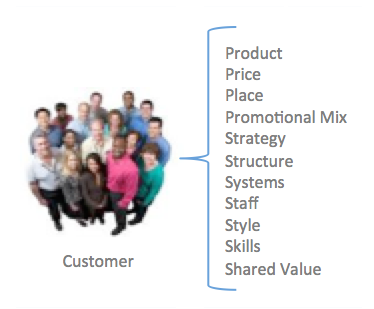
So in all of this I use 12 components as part of my framework of thinking where 11 of these components are connected back to the customer; have they been established, how can they be optimized and what is impacting them negatively? Business is rather complicated to say the least, so I am not suggesting there is a magical check list to cover it all but this does help to frame one's thinking, develop an understanding of the situation, support planning as well as solution development for identified problems. It has been very useful for me over the years.

So what happened to the lemonade stand you may ask? Well the last I heard the operations expanded to 100 little kids, 30 stands aligned to high foot traffic areas with an expanded offering of lemonade, fruit punch and apple juice; Management is concerned with shortfalls in revenue and I suspect its due to supply chain issues as the structure and supply chain just didn't keep up with the growth.

gpe

* 4P Marketing Mix was proposed by marketer E. Jerome McCarthy in 1960, which has since been used by marketers throughout the world

** 7S Model is a management framework developed by well-known business consultants Robert Waterman and Tom Peters.

*** This of course is simplified and also assumes responsible financial and legal management. 

Every man has a story... even the Bumble Bee*

The following is the original and the rewrite can be found by clicking here.

I was in the book store wandering around, basking in the feeling of being over stimulated with the vast amount of, you know.... books. I buy on-line and down load to my Kindle but given the choice I would rather meander the aisles for hours just looking, touching, picking up and putting down - it's spiritual. As I am wandering euphorically I come to a wall of books simply entitled "Every man has a story" - All nicely subcategorized for my perusing pleasure.

It struck me that it is true, we all have a story... for most of us, still figuratively being written and edited. It was here that I also realized I am fascinated with those people who defy the "odds"... you know, those people who, if you saw them on paper you would simply shake your head and say "I don't see it", yet somehow, they literally go on to change our world. 

Like all of us, we compare, contrast and look for that common denominator in those we admire so we ourselves can understand, intellectualize, reproduce and emulate these qualities.  So with that said, please play along with me as we look at Abraham Lincoln, Andy Warhol, Billie Beane and the Bumble Bee with regards to defying the odds per se. (An eclectic group right?)

It took me a while to finish the book "Team of Rivals" by Doris Kearns Goodwin, which chronicles the political genius of Abraham Lincoln - well worth the read. Let me quickly summarize: A rather tall, self-taught lawyer from the back woods of Illinois defies all the odds of the day to become the 16th President of the United States. Knowing the country is a "house divided" over the issue of slavery, which would most likely catapult the country into a war between brothers, he proceeds to assemble his cabinet with his political rivals navigating through 5 years of civil war; bringing the 13th Amendment into existence abolishing slavery and ultimately ending arguably one of the bloodiest wars in human history. 

In the mid 1950's, there was an avant garde movement establishing itself that ultimately would give birth to what we now know as Pop Art; redefining that art can be defined as anything and not just what the so called "establishment" defines as art. In the late 50's a young, awkward, gay, introverted, commercial artist living in New York joined this movement - Not only did he help redefine what was considered art, he actually created a new form of art that had previously never been seen. Everyone recognizes and defines those multi-image silk screens of celebrities as a "Warhol"... right away... there is no other. Andy Warhol created and defined an art form.

Billy Beane, the general manager of the Oakland Athletics was able to consistently field a winning baseball team with a budget substantially less than his competitors. His story is one of how, in a practical sense, he changed the way baseball needed to be managed. Outlined in the book Moneyball and popularized by the movie of the same name, Billie Beane and his team developed a radically different method for getting the most value for the players that play the game.

And now we humbly get to the bumble bee, you know, the short, stubby, small winged bee that moves around your garden industriously looking for nectar and pollonating each flower it hovers to - Did you know in the 1930's the French entomologist August Magnan noted that the insect's flight is actually impossible? Bumble Bee ignorance verses Human arrogance. 

Academics, writers, pundits and entomologists have produced countless books, white papers, blogs, videos, movies, exhibits (and the like) exploring who these four are, their achievements and the impact they have had. So let's simply say there is nothing I will say that will have any radical impact on the current cornerstones of thought; it wasn't really my intention anyway, so I have not lost sleep or weight due to worry. I was curious though to see if there was any commonality among the four, which may define those factors that defy those odds I refer to.

What struck me as I looked at this was not when I looked at our four characters individually but as an aggregate - some characteristics simply leapt out at me: Leadership with Lincoln, a visionary in Warhol, the ability to lead change by being different with Beane. There you go; Leadership, Vision and the ability to drive Change -  I like it!

So about now you are asking, "what about the Bee?" My entomology is rusty, but I would be the first to say that there are few Bumble Bees leading visionary change regarding how pollen should be collected two meadows over; with that said though, the Bumble Bee is very industrious. Leadership, vision and change will never happen without a lot of this. I like it even better!

Oh yes, we eventually did figure out how the Bumble Bee was able to fly, which I am certain this validation is reassuring for the species... but the real point is the Bumble Bee simply "does what it does ", independently of what people have said it should be able to do - it simply does what comes naturally and what it believes in**. I think it is with this that the Bumble Bee has earned the right to be used in the same sentence with Abraham Lincoln.

So now I really like it!

 Leadership, vision, an agent of change, hard work and a simple belief in your self. This is something to emulate for sure when defying the odds.

gpe

* For the biologists in the crowd it is not lost on me that those Bumble Bees flying around the garden are female.

** I have taken a little artistic licence here with regards to the Bumble Bee having the neurological capacity to "believe". I hope you get my point though and don't hold it against me.


In case of emergency, break glass and read...

When you find yourself standing alone; fighting the good fight on three fronts, doing what you believe to be right, when only you see it, and exhausted to the point of redefining sleep deprivation?  For you...

"It is not the critic who counts; not the man who points out how the strong man stumbles, or where the doer of deeds could have done them better. The credit belongs to the man who is actually in the arena, whose face is marred by dust and sweat and blood; who strives valiantly; who errs, who comes short again and again, because there is no effort without error and shortcoming; but who does actually strive to do the deeds; who knows great enthusiasms, the great devotions; who spends himself in a worthy cause; who at the best knows in the end the triumph of high achievement, and who at the worst, if he fails, at least fails while daring greatly, so that his place shall never be with those cold and timid souls who neither know victory nor defeat." *

and this...

"I know you are taking it in the teeth, but the first guy through the wall... he always gets bloody... always. This is threatening not just a way of doing business... but in their minds, it's threatening the game. Really what it's threatening is their livelihood, their jobs. It's threatening the way they do things... and every time that happens, whether it's the government, a way of doing business, whatever, the people who are holding the reins - they have their hands on the switch - they go batshit crazy." **

and finally this...

"For a seed to achieve it's greatest expression, it must come completely undone. The shell cracks, its insides come out and everything changes. To someone who doesn't understand growth, it would look like complete destruction. ***

gpe

* Excerpt from the speech "Citizenship In A Republic"delivered at the Sorbonne, in Paris, France on 23 April, 1910 by Teddy Roosevelt

** John Henry speaking to Billie Beane in the movie MoneyBall

*** Cynthia Occelli